

Student Story - Rhonda
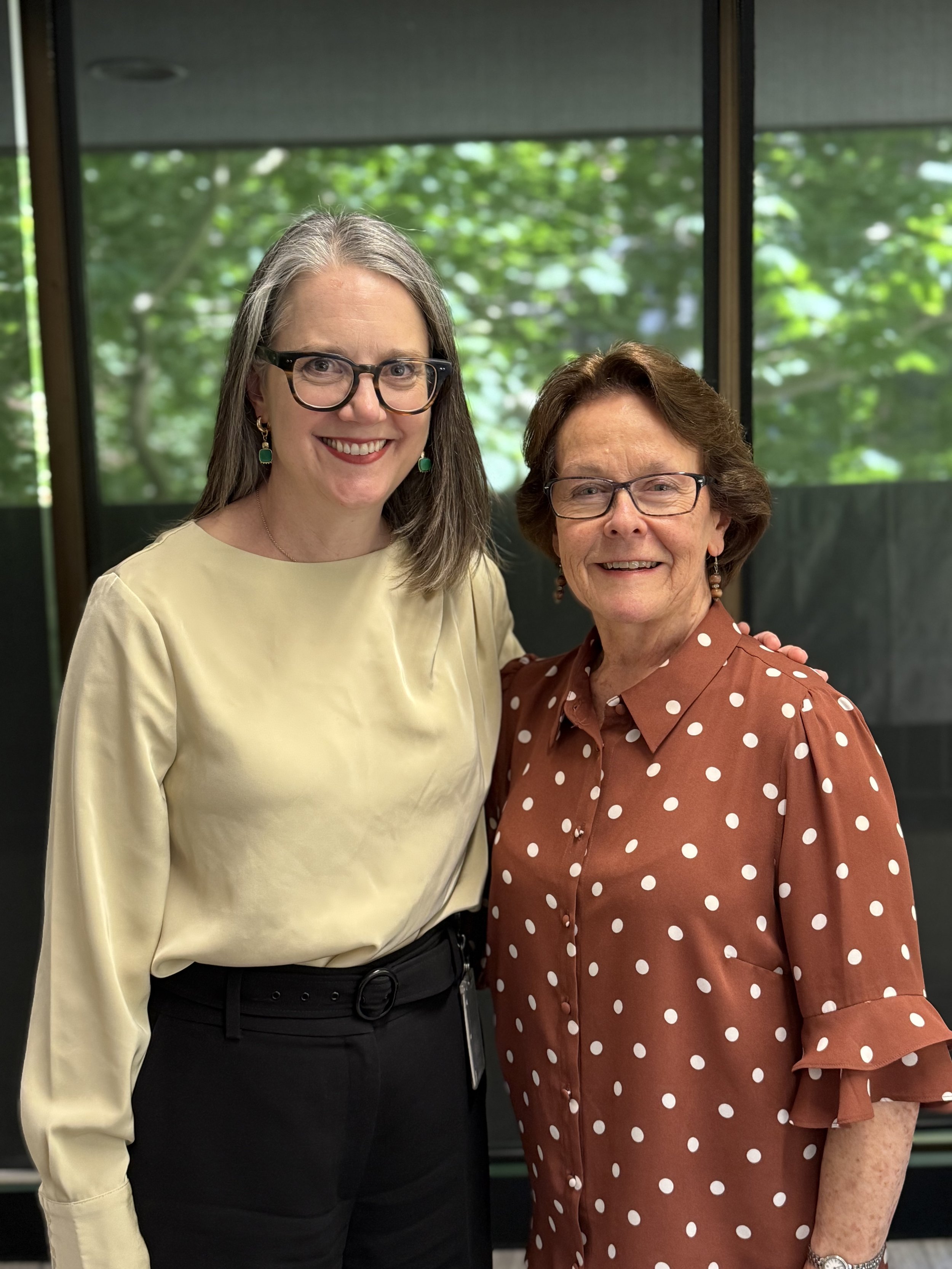
Interview with Rhonda.
We’re delighted to introduce you to Rhonda today.
As Rhonda reflects on her study of Christian Spirituality, she shares how the practice of Visio Divina, and an image of Mary anointing Jesus’ feet helped her think more deeply about love, trust and surrender.
Q: Rhonda, what drew you back into study at this stage of life?
Well, I’m semi-retired now. I work two days a week in a casual job, in the library at SMBC, which I very much enjoy.
I decided to undertake a little bit more study for a few reasons. One was to keep my brain active, to keep engaged, and to keep learning about God, because you can never come to the end of learning about God.
I also wanted to be involved in another community of people.
Q: You’ve been studying Christian Spirituality with Di Morgan. What has surprised you?
Christian spirituality is probably something that people are not used to dealing with in their study.
The aim of the course is to look at spiritual disciplines, and the spiritual traditions that lay behind them, on a pathway to learning more about God. And to open ourselves to the Holy Spirit to do the work of transformation in our lives to conform us to the image of Jesus.
I was surprised that there were so many spiritual practises that can foster our spiritual lives. I learnt another one this morning. It was called unplugging, which means unplugging from all the media and what goes on around us.
And there are some spiritual practises for individuals and some for groups, some that you've heard of, such as retreats and meditation and being in a small group.
Q: You’ve described Visio Divina as a way of prayerfully contemplating an image. What happened when you practised that in class?
But the one spiritual practise that I had not heard of before and that I found very comfortable with me was the practise of Visio Divina.
It’s also called “sacred seeing”—it involves prayerfully inviting God to speak to our hearts as we contemplate an image, some part of creation, or even a stained-glass window in a church.
Romans tells us that creation is a manifestation of God’s glory, his eternal power and divine nature. We can wonder at what God has created and be aware of his presence in the beauty of it—the stars in the sky at night, the flowers of the field. They all testify to God’s lavish love for the creation he made for us.
And it draws us, I think, into his presence.
But Visio Divina is also particularly associated with art and images or a photograph.
And as we reflect and contemplate on an image, the Spirit can speak to us and make us aware of issues in our life or can draw us closer into the love of Jesus.
And just last week Di had us reflecting on this image and it's Mary anointing Jesus feet.
Q: As you sat with that image of Mary anointing Jesus’ feet —but prayerfully noticing what it stirred in you, what drew your attention?
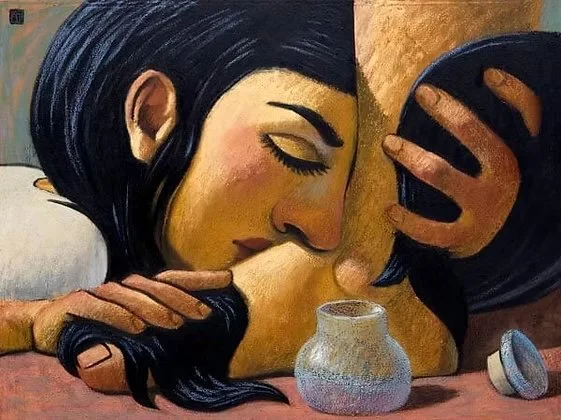
Annointing His Feet #2, by Wayne Forte. Used with permission.
We journaled about it during the course of that time, so I’d like to read a bit now...
Mary's heart is so full, so very full of him.
Nothing else matters, not the jar of very expensive perfume, now empty.
Nothing else matters at this moment, not the poor, not the household, not the others, not even her.
Nothing else matters but him, the beloved.
He is far too precious.
He is gentle but strong.
He is loving and kind.
He will stoop down to be with her, and she is fully free to express herself to Him in this way.
She can do this for him, and he will not refuse.
He accepts her adoration with gentleness and humility Himself.
He is God, but He takes time for Mary.
Amidst the goings on of the dinner party, the guests, the disciples, and the household, she has declared herself exclusively His.
My Beloved, thank you.
Thank you for sharing that, Rhonda. Your words are very beautiful––thank you!
Q. What is one way that your study has helped you to love Jesus more?
There was another concept I hadn’t really given much thought to in the Christian life: the concept of surrender.
For most of my Christian life, I’ve had running in the back of my head: “Trust and obey. There’s no other way to be happy in Jesus but to trust and obey.”
But during the course, some of the readings helped me realise that you can trust and obey, but that may not necessarily reach into your heart.
And Christ calls us to transformation from the inside out—a transformation of our heart.
I think it’s probably part of being raised and studying theology before in a very cognitive and intellectual way. I thought “trust and obey” could only be a submission to God's authority. And so the rest of our person can be left a little unchanged.
But surrender is almost like the image of Mary: she gave herself fully, as a whole being, to Jesus.
And that's what God wants. He wants our hearts and our love.
And surrendering is a very vulnerable thing. You expose yourself to somebody else.
But we can surrender to Jesus because he is who he is. He's perfectly faithful, he's honouring us, He's absolutely and fully love.
And there's no other attribute of God that the Bible describes in this way: it doesn't say “God is justice” or “God is law”, but “God is love”.
And so, the challenge for me is to surrender. To practise surrender and to give myself fully to Jesus who is madly, wildly in love with me.
———
We’re grateful to Rhonda for sharing so honestly with us. Her reflections are a beautiful reminder that theological study is not just about gaining knowledge, but about being drawn more deeply into the love of Christ.