

It's hard to imagine Christmas without all the singing. As a church musician, I can attest to the incredibly heavy load we carry during the Christmas season! Carol services, community events, Christmas parties, and more all come with the unmistakable soundtrack of Christmas songs (some much better quality than others!). For me, the season means long rehearsals in the choir stalls of our sandstone church, poring over complicated harmony arrangements, and stretching my vocal cords to reach those impossibly high descant lines (ouch!). I'm often exhausted by the time Christmas Day rolls around, but it is always, always worth it for the joy of the singing.
These songs make Christmas feel… like Christmas!
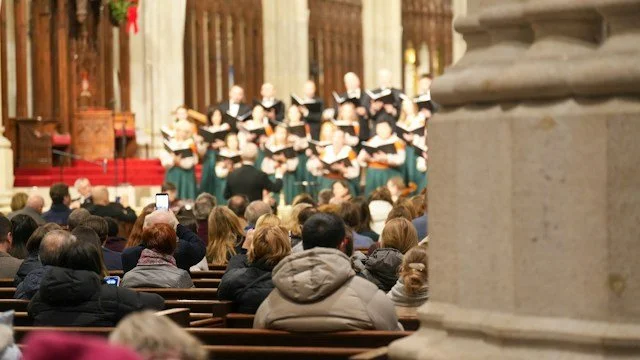
Singing in response to the wonder of the incarnation is natural and not new at all. In fact, it is one of the very first responses.
In Luke 1, Mary is visited by the angel Gabriel, who tells her this:
"Do not be afraid, Mary; you have found favour with God. You will conceive and give birth to a son, and you are to call him Jesus. He will be great and will be called the Son of the Most High." (Luke 1:30-32).
Despite her confusion and fear, Mary answers resolutely: "I am the Lord's servant." And she responds by singing, praising her good and faithful God. But she is also honest, singing about her humility. Mary's lowliness was painfully evident: a young, vulnerable woman whom God chose to notice.
My own experience was different, but it has given me a small window into her song. As a mother who experienced three high-risk pregnancies, there is little else that has humbled me in quite the same way. I was poked and prodded and observed, deeply aware of how little control I had over my own well-being, let alone that of my unborn baby. At times, it truly felt like I had little dignity left to protect as childbirth brought with it new depths of pain, fear and brokenness. Without projecting too much of my own experience onto Mary, I can only begin to imagine what it was to bear the burden of this promise. And what was Mary's response? She sings with full confidence that the Mighty One is with her, lifting her and blessing her.
Mary's praise paints a picture of a world turned upside down: a vision of God's kingdom where authority is subverted, justice reigns, and light shines in the darkness. It also offers a glimmer of great hope to come. The baby in Mary's womb is the eternal Word of God taking on human flesh, who will grow up to experience the ultimate lowliness: bearing the forsakenness of the cross. But, like Mary, he is not left there. In the resurrection, the Father raises him and lifts him to glory. This is a victory we share in; in Christ, we too are lifted, even as we wait for that glory to be fully revealed. This Christmas we can celebrate these truths: the incredible reversal from humility to exaltation, and sing along with Mary, without abandon, "Holy is his name!"
Yes, at Christmas we spend dedicated, joyful time celebrating the Word made flesh.
"The Word became flesh and made his dwelling among us. We have seen his glory, the glory of the one and only Son, who came from the Father, full of grace and truth" (John 1:14).
But our response to the Word made flesh isn't limited to December. Paul writes to the church: "Let the word of Christ dwell in you richly, teaching and admonishing one another in all wisdom, singing psalms and hymns and spiritual songs, with thankfulness in your hearts to God" (Colossians 3:16).
The eternal Word who took on flesh is the Christ whose gospel we are called to treasure. When we gather, our songs aren't just a reaction to the message of Christ; they are one of the ways it sinks down deep within us. Paul’s parallel words in Ephesians show who is at work in this: “Be filled with the Spirit, speaking to one another with psalms, hymns, and songs from the Spirit” (Ephesians 5:18-19). By the Spirit, this word on our lips and in our hearts transforms our lives into people of the gospel.
So this Christmas, sing! Praise him for his faithfulness, for the wonder of the Word made flesh and the salvation promise that was fulfilled. Embrace the extra singing and those squeaky, high descant lines as we sing these life-changing truths together. But don't stop there! Keep singing the same gospel every Sunday after.
For reflection:
What truths about Christ's coming most move you to praise?
How might singing help the gospel dwell more deeply in your heart? Share your thoughts on singing on today’s Facebook post
Prayer: Lord God, fill our hearts with wonder at the coming of Christ. Let his word dwell richly within us, shaping our thoughts, our words, and our worship. May our songs, at Christmas and throughout the year, bring glory to you and joy to your people. Amen.

Alanna teaches music ministry and loves helping churches sing rich theological truth together. She is passionate about the way music shapes our worship, discipleship, and life together as God's people